


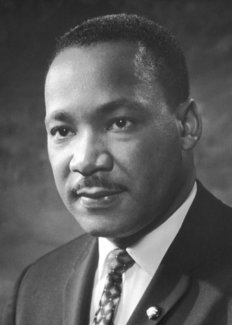
“We must accept finite disappointment, but never lose infinite hope”
Martin Luther King, Jr., (January 15, 1929-April 4, 1968) was born Michael Luther King, Jr., but later had his name changed to Martin. His grandfather began the family’s long tenure as pastors of the Ebenezer Baptist Church in Atlanta, serving from 1914 to 1931; his father has served from then until the present, and from 1960 until his death Martin Luther acted as co-pastor. Martin Luther attended segregated public schools in Georgia, graduating from high school at the age of fifteen; he received the B. A. degree in 1948 from Morehouse College, a distinguished Negro institution of Atlanta from which both his father and grandfather had graduated. After three years of theological study at Crozer Theological Seminary in Pennsylvania where he was elected president of a predominantly white senior class, he was awarded the B.D. in 1951. With a fellowship won at Crozer, he enrolled in graduate studies at Boston University, completing his residence for the doctorate in 1953 and receiving the degree in 1955. In Boston he met and married Coretta Scott, a young woman of uncommon intellectual and artistic attainments. Two sons and two daughters were born into the family.
In 1954, Martin Luther King became pastor of the Dexter Avenue Baptist Church in Montgomery, Alabama. Always a strong worker for civil rights for members of his race, King was, by this time, a member of the executive committee of the National Association for the Advancement of Colored People, the leading organization of its kind in the nation. He was ready, then, early in December, 1955, to accept the leadership of the first great Negro nonviolent demonstration of contemporary times in the United States, the bus boycott described by Gunnar Jahn in his presentation speech in honor of the laureate. The boycott lasted 382 days. On December 21, 1956, after the Supreme Court of the United States had declared unconstitutional the laws requiring segregation on buses, Negroes and whites rode the buses as equals. During these days of boycott, King was arrested, his home was bombed, he was subjected to personal abuse, but at the same time he emerged as a Negro leader of the first rank.
In 1957 he was elected president of the Southern Christian Leadership Conference, an organization formed to provide new leadership for the now burgeoning civil rights movement. The ideals for this organization he took from Christianity; its operational techniques from Gandhi. In the eleven-year period between 1957 and 1968, King traveled over six million miles and spoke over twenty-five hundred times, appearing wherever there was injustice, protest, and action; and meanwhile he wrote five books as well as numerous articles. In these years, he led a massive protest in Birmingham, Alabama, that caught the attention of the entire world, providing what he called a coalition of conscience. and inspiring his “Letter from a Birmingham Jail”, a manifesto of the Negro revolution; he planned the drives in Alabama for the registration of Negroes as voters; he directed the peaceful march on Washington, D.C., of 250,000 people to whom he delivered his address, “l Have a Dream”, he conferred with President John F. Kennedy and campaigned for President Lyndon B. Johnson; he was arrested upwards of twenty times and assaulted at least four times; he was awarded five honorary degrees; was named Man of the Year by Time magazine in 1963; and became not only the symbolic leader of American blacks but also a world figure.
At the age of thirty-five, Martin Luther King, Jr., was the youngest man to have received the Nobel Peace Prize. When notified of his selection, he announced that he would turn over the prize money of $54,123 to the furtherance of the civil rights movement.
On the evening of April 4, 1968, while standing on the balcony of his motel room in Memphis, Tennessee, where he was to lead a protest march in sympathy with striking garbage workers of that city, he was assassinated.
March on Washington 1963
King is born in Atlanta.
King is ordained to the Baptist ministry.
King graduates from Morehouse College with a B.A. in sociology.
King marries Coretta Scott in Marion, Alabama
King visits Washington, D.C. The U.S. Supreme Court rules segregation in public schools unconstitutional.
King is installed as Pastor of Dexter Avenue Baptist Church in Montgomery, Alabama.
King receives doctoral degree in systematic theology from Boston University.
In Montgomery, Mrs. Rosa Parks refuses to relinquish her bus seat to a white man and is arrested. This incident touches off a massive bus boycott, led by King.
After a successful city-wide boycott, Montgomery Bus Company announces integration of all public buses.
The Southern Christian Leadership Conference is founded. King is elected president. Time Magazine puts him on the cover.
King is invited to Shaw University in Raleigh, N.C. After his speech, the Sudent Nonviolent Coordinating Committee was born.
King writes the famous “Letter from Birmingham Jail” while imprisoned for demonstrating against the segregation of eating facilities in that city.
King delivers his “I Have a Dream” speech at the Lincoln Memorial during the “March on Washington,” the first massive national integrated protest march in America. Attended by over 260,000 people, the march brought international attention to the civil rights movement.
King attends the signing of the Public Accommodation Bill, part of the Civil Rights Act of 1964, by President Lyndon B. Johnson.
King receives the Nobel Peace Prize in Oslo, Norway.
Thousands of protesters begin the march to Montgomery, where King delivers a speech on voting rights.
The Voting Rights Act is signed into law by President Johnson.
King announces the formation of a “Poor People’s Campaign,” which helps both poor whites and blacks.”
King leads protesters in a march through downtown Memphis, Tennessee, in support of striking sanitation workers.
King delivers his “I’ve Been to the Mountain Top” speech in Memphis.
While speaking from the balcony of his hotel room in Memphis, King is assassinated by a sniper. James Earl Ray is later convicted of King’s murder.
President Ronald Reagan declares the first observance of Dr. Martin Luther King Jr.’s birthday to be a national holiday, celebrated on the third Monday of each January hereafter.
“History will have to record that the greatest tragedy of this period of social transition was not the strident clamor of the bad people, but the appalling silence of the good people.”

By Kendra Pierre-Louis April 3, 2018 Climate Forward
There’s an ongoing crisis — and tons of news. Our newsletter keeps you up to date. Credit… Photo Illustration by The New York Times A half-century ago, the Rev. Dr. Martin Luther King Jr. was killed in Memphis on the balcony of the Lorraine Motel. To get to the site, which is now the National Civil Rights Museum, you can cross through neighborhoods that are as much as 97 percent black or as much as 93 percent white. Dr. King preached that segregation was harmful not only to black Americans but also to the nation as a whole. He died before the modern environmental movement, but a growing body of research around pollution and health shows that his belief about segregation hurting everyone extends to the environment as well. Many American cities that are more racially divided have higher levels of pollution than less segregated cities. As a result, both whites and minorities who live in less integrated communities are exposed to higher levels of pollution than those who live in more integrated areas. “The price that America must pay for the continued oppression of the Negro is the price of its own destruction,” Dr. King wrote in a 1962 address, “An Analysis of the Ethical Demands of Integration.” In it, he set out the political, ethical and spiritual reasons he believed that segregation was harmful for all. Some historians say his thoughts are applicable to understanding environmental issues today. Researchers have known since at least the 1980s that black and Hispanic communities have higher levels of pollution and its associated harmful health effects than white communities, even when controlling for income. Studies show that racial discrimination leads governments and companies to place polluting facilities, like landfills, power plants and truck routes, in black and Hispanic communities. Race is not the only factor in environmental inequality — poorer people experience more pollution than wealthier people. But for blacks, race trumps income. Middle-class blacks experience higher levels of pollution than low-income whites. Over the past decade, more researchers have focused on the correlation between segregation and broad pollution exposure. Residents of a city like Memphis, they have found, are exposed to more pollution than those living in a city like Tampa, Fla., which is less racially divided.
Latest News on Climate Change and the Environment Card 1 of 5 Dire warnings. Global warming may be happening more quickly than previously thought, according to a new study by a group of researchers including former NASA scientist James Hansen, whose testimony before Congress 35 years ago helped raise broad awareness of climate change. Aid for climate shocks. Wealthy countries have decreased the amount of money they commit for helping developing countries cope with the effects of climate change, even as the need for that spending has grown, the U.N. said in a report. Aid for climate adaptation fell to $21 billion in 2021, the latest year for which comprehensive data is available, a drop of 15% from 2020.
A peak in fossil fuel use? For more than a century, the world’s appetite for fossil fuels has been expanding relentlessly. But the International Energy Agency now predicts that global demand for oil, natural gas and coal will peak by 2030, partly driven by policies that countries have already adopted to promote cleaner forms of energy and transportation. Atlantic hurricanes. Hurricanes in the Atlantic Ocean are now twice as likely to grow from a weak storm into a major Category 3 or higher hurricane within just 24 hours, according to a new study. When hurricanes intensify so quickly, it may become more difficult to make predictions and prepare for disaster. On the brink. The Amazon rainforest, where a fifth of the world’s freshwater flows, is reeling from a powerful drought that shows no sign of abating. Likely made worse by global warming and deforestation, the drought has fueled large wildfires that have made the air hazardous for millions of people, while also drying out major rivers at a record pace. “Even though white residents in segregated cities were better off than residents of color in those segregated cities, those white residents were worse off than their white counterparts in less segregated cities,” said Rachel Morello-Frosch, a professor of environmental health at the University of California, Berkeley. Studies have found this relationship between segregation and air pollution, water pollution and even noise pollution. A large body of literature shows that high exposure to certain pollution can cause asthma, heart disease and many other negative health effects. “It’s so much pollution that it led not only to very high exposure to minorities but it actually bounces back to at least some whites,” said Michael Ash, a professor of economics at the University of Massachusetts, Amherst, and an author of a study that looked at the impact of segregation on pollution levels. There are several ways to look at segregation: by isolation, defined as the degree to which ethnic groups are clustered together, or by dissimilarity, defined as how evenly two groups are spread across an area. By either method, pollution is higher in more segregated communities.